|
WHY is Prism Patches different?
All companies, it seems, tell you what great service, quality, turnaround speed, and so forth they offer. Satisfaction Guaranteed!
Easy words. But, can you count on them? LBJ is reputed to have said, "Whenever someone tells me how honest he is, is when I put my hand on my wallet."
Here's what you won't hear from those companies, because it doesn't occur to them: The costliest
thing a company can sell is something cheap! It takes much more time answering complaints and fixing problems than does the sell, and you neither acquire long-term customers nor reap the referrals from satisfied customers. After more than ten years, providing millions of patches to thousands of satisfied customers, the vast majority of my business comes, not from first-time customers, but from repeat customers, referrals from current customers, and referrals from the referred customers.
ALL patches are made overseas,
the overwhelming majority in the PRC
(Peoples Republic of China). PRC companies think a lot differently than do Americans. Virtually all patch companies that you, the end user, will consider are small operations that haven't much pull with these Chinese manufacturers. Chinese most often would rather argue with you than admit a mistake and fix it. Unless the patch company from whom you bought your patches has their own facility, that company often has to fix the mistake at their expense or pass their inability to deal effectively with the Chinese source to you. Which choice do you trust them to make?
My patches are made in Taiwan (ROC-Republic of China) by a husband and wife team that concentrates on quality. Moreover, I am their only significant customer.
It's been a proven relationship for many years, and one that benefits you. We, both, do our best to not make mistakes because we fix them at our expense, no questions asked. This is most unusual in dealing with
Chinese and not uncommon in dealing with Taiwanese, which means you are unlikely to find another company that can make promises to you they can keep when the chips are down.
If my manufacturer makes a mistake, they fix it at their expense. If I make a mistake, I fix it at my expense. Of
course, it doesn't matter who's fault it is, as long as any problem is fixed speedily and without hassle. But, what if you make a mistake? While this doesn't happen often because you receive a proof and can make changes at that time, it does happen infrequently. In those cases, I remake your patches for half-price. While it wasn't my mistake, I don't want to make money on yours.

I have never had a dissatisfied customer! What?
Really! I fix any problems, and if you're still unsatisfied, return your patches and receive a full refund. I've had to do the latter two or three times in the last ten years--even these two or three had obviously changed their minds about buying patches--, and I don't remember any occurrence within the last five. I don't need your money (because, frankly, I've made a lot by doing things right over the last decade), and it's not worth my time and effort to fight the issue, if I don't happen to agree.

What about quality--so much for fixing mistakes that rarely happen? Quality lies in the ability of the digitizer
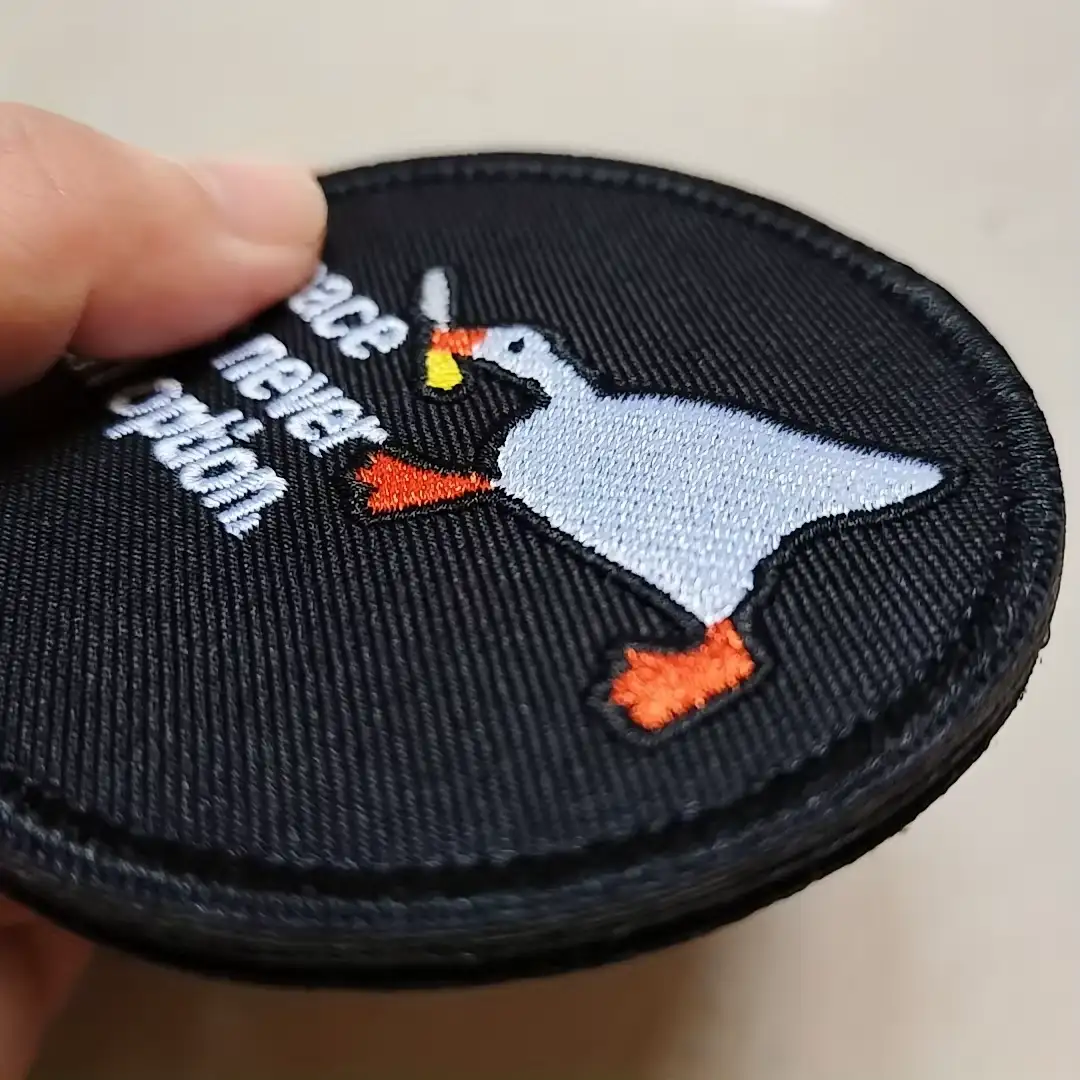
and the stitch density. Like everywhere, finding people who excel in their art is difficult and more expensive--top people cost more and are more difficult to find; and the more a manufacturer can reduce the number of stitches used for a patch, the less thread he uses and, more import, the less time it takes to sew them. Every penny saved this way goes straight to the bottom line--profit. While it's easy to control stitch density, if one wants to and has the ability; the quality of the digitizing is another matter. My guy in Taiwan is very good. I'm fortunate--and so are my customers, because of this. An empty assurance? It could be, except for my "expensive, cheap goods" belief, and that it's much more likely the owner/manufacturer of a patch company will be an excellent digitizer first and a patch maker second. Most manufacturers hire digitizers to do this, and they only pay for run-of-the-mill abilities.
Don't be fooled by art proofs that look like they've been embroidered. Most patch companies will send you art that has been "Photo Shopped" with a "mask" that makes the art look embroidered. There can only be one reason for this: to have you believe this is how your patches will look. If only it was this easy. Embroidery has come a long ways in recent years--mostly in efficiency, but it's still needle and thread. Lettering size is the most critical element (see Helpful Hints & FAQ).
The amount of detail is next. For example, you'll not be able to have girls sitting around a campfire, roasting marshmallows, with a tent and trees in the background, a starlit sky, and attendant lettering on a 2" or 2.5" patch, and probably not on a 3" patch. But, you can create this art with a graphic program, say, at 5" and reduce it to 2", and, depending on your graphics card and monitor resolution, have it look fine at this size. While this art might require a 5" patch for the your design to embroider cleanly, most companies will take your reduced art, that won't embroider well at the size patch requested, overlay an "embroidered effects mask" on it with Photo Shop, and send it to you as an example of how your patches will look. Although they won't make this statement, why else would they send this to you? If they do this, what other ready assurances of theirs are believable? Are you like me and think this type of practice dishonest?
Delivery time
is another one of these ready assurances. I suspect blaming the delivery company, e.g., UPS, USPS, FedEx..., is the ready response when delivery dates aren't met. There is no way you'll have patches in a week from ordering from any company, except in rare situations or reorders (and not always on reorders).
I hope the above has help you answer your questions concerning which, of the many, patch companies to better consider, as well as
given you a little better understanding how this business works and with whom you are really dealing.--Chuck Packer
|
|